What you will need:
Your Binoculars
Duck Tape (I used crome like Duct Tape)
Masking Tape
Scissors
Ruler/Straight Edge
Spiral Notebook back.
1. Get your binoculars. 
#2. Lay ends of surface you wish to cap on notebook backing. Then, trace surface on to backing with pen or pencil.

#3. Cut out circles that you created in step 2. 
#4. Measure the depth you wish your caps' side should be. Then use a ruler/straight edge and make strips using those measurements. You need to have a long strip so it will fit around the lens (plus additional overlap). 
#5. Cut out previously made strip and place around edge of capped area (the lens you are making the cap for). Use masking tape to tape adjusted size. You want it snug but lose so you can take it off easily. Tape both the inside and outside of the circular shape you create. 
#6. Place the round piece over the lens while you have your edge piece. Then use masking tape to "mask" up the lens cap. I used masking tape because it was much easier to work with than duck tape. 
#7. Now cover the whole thing with duck tape while it is on your lens.
#8. Take off cap once it is totally covered.
#9. Trim off excess tape to clean things up.
#10. You're Done!!!!!!
Friday, September 25, 2009
Making Binocular Lens Caps
Monday, September 21, 2009
Mercury and Saturn getting all up ons... Sept 22 in AM
If you go out in North America before sun rise on Sept. 22, 2009 and look to the East just a few seconds before sunrise. Just a little above the eastern horizon you should see the planets Mercury and Saturn appearing only 3/10ths of a degree apart. This might be difficult to see as they are not very far from the sun. I you have a flat horizon to the east of where you are you might want to give it a try.
Wednesday, September 16, 2009
Saturday, September 12, 2009
"Uranus at Opposition.

September 17, 2009
"The blue-green planet will be at its closest approach to Earth. This is the best time to view Uranus, although it will only appear as a tiny blue-green dot in all but the most powerful telescopes." - http://www.seasky.org/astronomy/astronomy_calendar_current.html
Monday, September 7, 2009
Generosity of Astronomers

Soon after I became interested in Astronomy, I began to learn how generous astronomers are. I was around the age of 12 years old when I was bit by the astronomy bug. I remember meeting the local astronomy group in my hometown of San Angelo, outside of Hasting's Books Store; they had telescopes on display outside. Soon, I joined up.
I was lucky to know a man by the name of Ted H., a local architect and builder who lived about a block from my house. I credit Ted, for my love of astronomy today. Ted would pick me up for each meeting that the San Angelo Astronomical Association had. I believe he also paid for my membership for a few years. After meetings, we usually ended up a the local Denny's and Ted usually picked up the tab on that too when I found my allowance lacking.
Soon, I became Ted's assistant astronomer, see he owned a solid tube Meade Dobsonian size 16", needless to say it took two people to set up and load in his Ford Expedition. So, before star parties I'd walk over to his house then we'd load up that huge white tube in his SUV on a custom built holder that prevented it from rolling around. Then we'd drive out to the star party. Sometimes it was at the West Texas Boys Ranch where we showed the wonders of space to the residents there, but more often then not we headed to Nova Ranch west of San Angelo, Texas. Once I remember Ted offering to take me to Texas Star Party but my parents didn't want me to take off school for that.
I remember Ted teaching me how to use his 16" dobsonian, he taught me how to navigate the stars by star hopping using the Telrad and SkyAtlas 2000 epoch as my guide. What an experience for a Junior High Student! Today, I own many telescopes including a Meade Lightbridge 16" (one gets spoiled on aperture).
When I wanted to get my first "real" telescope, it was Ted who gave me my first job ever. I worked to clean up his construction sites and also to do some odd jobs around his house. For all that Ted and his wife Rose has done I'm truly grateful, for I wouldn't be the astronomer I am today if it weren't for Ted and Rose.
There were many other members of the San Angelo group that I learned to appreciate such as Bruce M. who used to occasionally take me to star parties in his Gold Ford Van with the Club's logo attached on the sides. Bruce also let me the use of the 6" Celestron Telescope you see in the photo above. Also, the owners of Nova Hill for allowing us to come make use of the dark skies (their names have slipped my mind).
I've lost contact with much of those people in the San Angelo group who helped my start in astronomy but I'm grateful to each and everyone of them.
I moved to San Antonio about 2 years ago and I found the generosity that I found in San Angelo to be alive and well here in the San Antonio Astronomical group. Soon after moving I bought a 10" dobsonian off Craigslist and one night, my first time at the dark sky site, one man gave me a nice old used 32mm eyepeice that I used for about a year until that fateful day a while back when it shattered on the floor of my garage. This act of kindness was by a man I only met minutes before!
Last January, I started to build my own telescope a 4.5" f/8 Reflector and I found many of the needed parts from members of the San Antonio group who willingly gave me parts for free for my sub $100 telescope project.
At star parties I've been able to share filters and eyepieces with fellow astronomers and if it weren't for this openness I'd never have seen the Veil Nebula in my 16" Thanks to Bryan and Bill for lending me an OII and UHC filters on several occasions. At my last star party I forgot my star chart and Bryan was quick to offer one he had.
I hope that people will come to know me as a generous person just like I remember these people that I have mentioned. Recently I have started on a pet project of sorts. If i come across a "beginner" scope at a garage sale of thrift store I try to by it with the intentions of making it more usable by reworking the mount and working on focuser to have it use 1.25" eyepieces instead of the inferior .965's. I currently have 2 60mm refractors I intend of fixing up and then giving to budding astronomers.
I'm sure it is a safe bet that you're into astronomy because someone at one time was generous to you. Post a comment and share your story.
Saturday, September 5, 2009
LRCROSS - Get Your Telescopes Ready!

The LCROSS mission is basically every boys dream.."smashing stuff". NASA is smashing a satellite into the moon, literally.
According to NASA's LCROSS Page:
"Projected lunar impact is on October 9, 2009 at 11:30 UT (7:30 a.m. EDT, 4:30 a.m. PDT), +/- 30 minutes.
The impact time will be refined as the mission progresses. Two weeks prior to impact, the impact time will be known to within a second.
Check back on this webpage for the most up-to-date timing information."
With that said we still have over a month to wait. Now is the time to start planning and researching how you (YES YOU) can help with data collection for the LCROSS Project right from your backyard.
This is what NASA says about your involvement: "Mission scientists estimate that the Centaur impact plume may be visible through amateur-class telescopes with apertures as small as 10 to 12 inches. The LCROSS mission will actively solicit images of the impact from the public. These images will provide a valuable addition to the archive of data chronicling the impact and its aftermath...To participate in the LCROSS Amateur Observation Campaign, visit the LCROSS_Observation group."
Star planning and practicing those lunar photos.
Tuesday, September 1, 2009
Jupiter Lost it's Moons?? (take a look Sept 2-3)
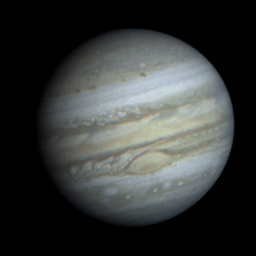
September 2nd through the 3rd. One will be able to see Jupiter without Moons. Jupiter can usually be seen with all or some of its four largest moons in binoculars and small telescopes however this is a very rare occurrence for it to be seen otherwise. But late on this night in most of the Western Hemisphere, the planet will be visible with no moons for nearly two hours.
Go take a look and let me know by posting a comment if you see this.
Source: http://www.seasky.org/astronomy/astronomy_calendar_current.html