The weather was cooperating rather nicely this week for observing so I headed over to McAllister Park with my “Big Red” dobsonian
telescope.
I sat up next to John K. and Bill B. Keith arrived a short time later with this 12”. Before dark we were already looking at the Moon and Jupiter. I noticed a shadow transitioning across the face of Jupiter and John K. confirmed this with his Explore Scientific Refractor.
I spent a good time looking and the Moon and this night I really enjoyed looking at the crater Gassendi which is on the edge of Mare Humorum, Clavius and Tycho were included with the usual features I observe when I can. I’d like to thank John and Bill for offering a lunar filter to me which made viewing way more pleasurable.
After looking at the Moon I when back to looking at Jupiter and we saw the moon that was transitioning in front of Jupiter now as a little bump on the edge of Jupiter. I checked in to every so often to look at the Moon and Jupiter and saw it move away from the face of Jupiter little by little.
I also decided to challenge myself to search for the Veil Nebula… and I knew the chances were slim and I was unsuccessful. I was not surprised that I couldn’t see it…I would have been surprised if I did see it! Perhaps I’ll try again from McAllister Park to see if on a moonless night.
Showing posts with label moons. Show all posts
Showing posts with label moons. Show all posts
Monday, November 22, 2010
McAllister Park with San Antonio Astronomical Assocaition- Nov. 17, 2010
Tuesday, September 1, 2009
Jupiter Lost it's Moons?? (take a look Sept 2-3)
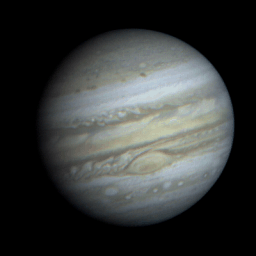
September 2nd through the 3rd. One will be able to see Jupiter without Moons. Jupiter can usually be seen with all or some of its four largest moons in binoculars and small telescopes however this is a very rare occurrence for it to be seen otherwise. But late on this night in most of the Western Hemisphere, the planet will be visible with no moons for nearly two hours.
Go take a look and let me know by posting a comment if you see this.
Source: http://www.seasky.org/astronomy/astronomy_calendar_current.html
Subscribe to:
Posts (Atom)